

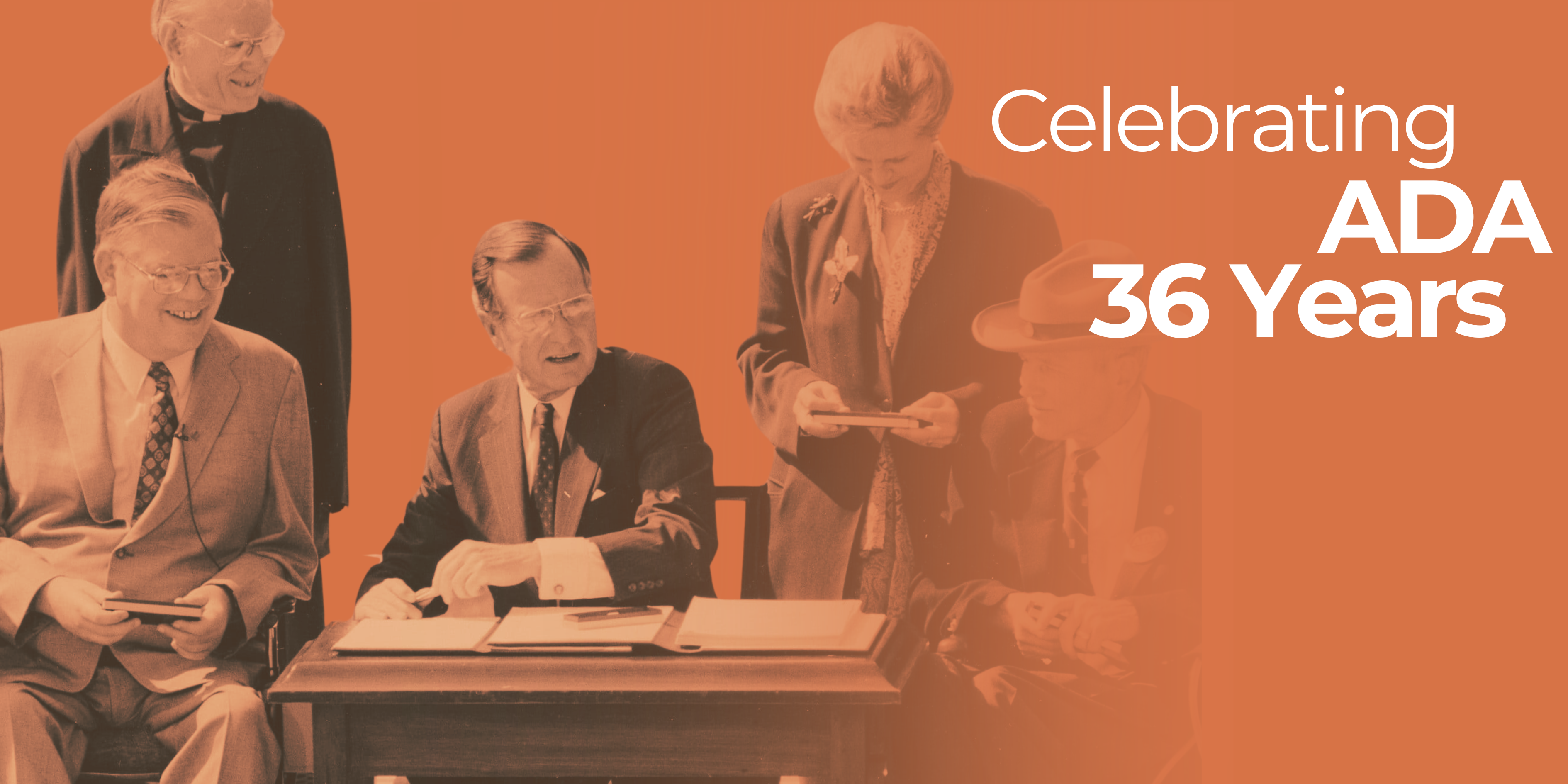
| Thirty-six years ago today, a civil rights law went into effect that said — in plain terms — disabled people belong everywhere. In jobs. In schools. On buses. In buildings. In public life. That was the promise. The promise is still being negotiated. |
What the ADA Was Built to Do
For anyone who wasn't around in 1990 — here's the short version.
Before the ADA, there was no federal law that broadly protected disabled people from discrimination in everyday life. You could be turned away from a job, denied access to a building, or excluded from a school program simply because of a disability, and it was perfectly legal. Disability rights activists had spent decades fighting that reality — organizing, protesting, and pushing Congress to act.
When President George H.W. Bush signed the ADA into law on July 26, 1990, it was built around four core goals:
|
| The scope The ADA wasn't just about ramps and parking spots. It covered jobs, schools, doctor's offices, buses, government buildings, websites, and anywhere the public goes. The idea was simple: disabled people are full citizens, and society has an obligation to include them. |
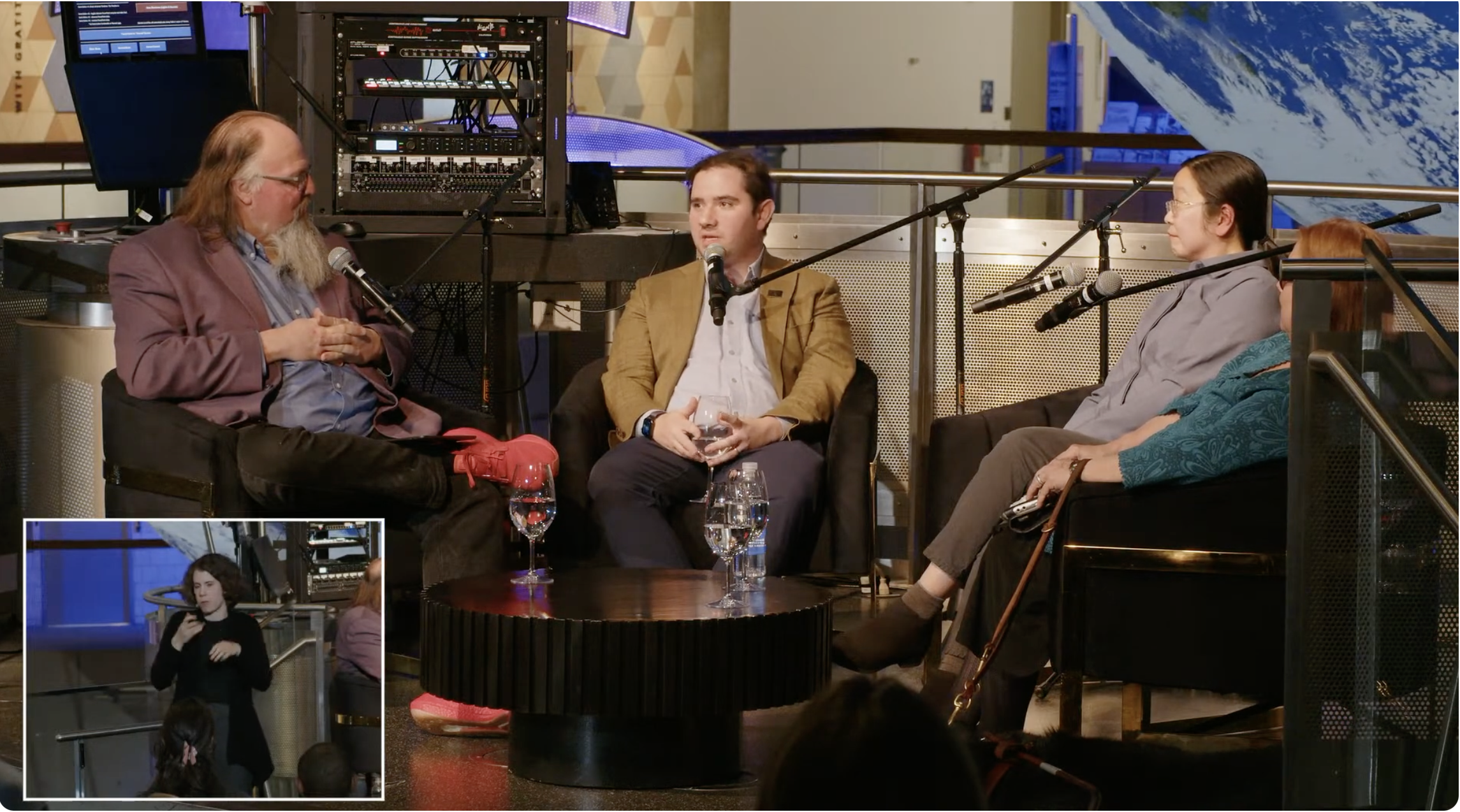
Want to go deeper on the history? This panel discussion from the Museum of Science Boston and Perkins School for the Blind is worth your time.
Thirty-six years later, that obligation is still being fulfilled — unevenly, slowly, and in some places, not at all. Here is where each of those promises stands today.
Want to learn more about the ADA? Visit ada.gov ↗The Law Created the Floor. We Haven't Built Much on Top of It.
The employment numbers tell one part of the story.
| 2025 Employment Data
* More than double the 4.1% unemployment rate for non-disabled workers. |
That gap has barely moved in years. The ADA didn't fail. The systems around it did.
What was supposed to come after the law — accessible transit, workplaces that actually accommodate people, schools that prepare disabled students for real careers — those pieces are still missing or incomplete. The law set a legal minimum. Most institutions stopped right there.
That is the central problem. Not the ADA itself. Everything that was supposed to follow it.
And now there is a new layer to it. Hiring algorithms and automated screening tools are increasingly filtering out neurodivergent applicants and people with disabilities — not because they aren't qualified, but because the systems doing the filtering weren't built with them in mind. AI was supposed to remove human bias from hiring. In practice, it often just encodes it faster.
Education: Protected on Paper, Uneven in Practice
The ADA covers schools. So does Section 504. Together, they give students with disabilities the right to equal access — to buildings, programs, and digital tools.
But rights on paper and rights in practice are not always the same thing.
About 1 in 5 college students has some form of disability. Schools are required to make their websites, apps, and course materials accessible. But many are still behind, and enforcement has been uneven. There are also growing concerns about proposals to move special education oversight out of the Department of Education entirely — a shift that advocates warn could weaken enforcement of IDEA, the law that protects disabled students' rights in schools.
When enforcement weakens, the families with the fewest resources are the ones who feel it most.
Healthcare: The ADA Says Equal Access. Reality Disagrees.
The ADA requires healthcare providers to be physically accessible and to communicate clearly with patients who have disabilities. Sign language interpreters. Accessible exam tables. Information in formats people can actually use.
In practice, those requirements are inconsistently met.
People with disabilities face worse health outcomes than non-disabled people — not because of their disabilities alone, but because of barriers in the system itself. Offices that are hard to navigate. Providers who aren't trained to work with disabled patients. Telehealth platforms that don't work with assistive technology. Patient portals that screen readers can't use.
Very few medical schools train doctors in disability-inclusive care. That gap in training becomes a gap in care — felt by every disabled person who has had to explain their own needs to a doctor who wasn't prepared.
| Worth knowing The ADA's Olmstead decision established the right to live in the community rather than in institutions. That right depends on home and community-based services — and those services depend heavily on Medicaid funding. When that funding gets cut, the ADA's promise of integration doesn't disappear on paper. It just becomes impossible in practice. |
Digital Access Is Still a Fight
The internet wasn't part of the original ADA. It didn't exist the way it does now. For years, digital accessibility lived in a gray area — technically required, but rarely enforced and even less often practiced.
New rules have tried to change that. Public entities are now required to meet web accessibility standards for their websites and apps. But compliance deadlines keep getting pushed back. In late 2025, two pending rules about accessible equipment and accessible routes in public spaces were dropped entirely by the Department of Justice. Experts are predicting more ADA website lawsuits in 2026 as a result — because when the government steps back, litigation steps in.
The gaps are still everywhere. Captions that were auto-generated and never checked. Alt text that just says "image." PDFs no screen reader can parse. Navigation that breaks without a mouse.
This is the accessibility work most organizations don't want to do because it never ends. It's not a project with a completion date. It's a practice. And most institutions haven't built it into how they operate — because the law hasn't forced them to, and culture hasn't demanded it yet.
A Lot of What Passes for Compliance Is Theater
The ramp that exists — but only at the side entrance. The captioned video where the captions are wrong half the time. The "accessible" bathroom behind three heavy doors. The job posting that says "equal opportunity employer" and then screens out anyone who doesn't fit a narrow mold.
Somewhere along the way, the floor became the goal. Do the minimum. Don't get sued. Move on.
That is not what disability rights advocates fought for. The ADA was meant to be a starting point — a foundation to build on, not a ceiling to bump against once and call it done.
And yet, too many institutions are still bumping against the floor.
What Moving Forward Actually Looks Like
This anniversary has made one thing clear: laws create possibility, but they don't create culture. Culture has to be built — in hiring decisions, in school policies, in design choices, in who gets a seat at the table when systems are created.
| Digital accessibility needs to be infrastructure, not an afterthought. Every organization that serves the public should have an accessibility practice built into how it operates — not just a policy document in a drawer. |
| Employers need to close the gap between accommodation policy and accommodation culture. Having a policy matters. Having a culture where people can ask for what they need without fear or friction matters more. |
| Disabled people need to be in the room where decisions are made. Not brought in at the end to review something already built. As leaders, designers, and policymakers shaping systems from the start. |
| The anniversary conversation needs to include accountability. Not just recognition of how far we've come — honest reckoning with how far we haven't. |
What We Owe Each Other
Disability touches every community, every family, and eventually most lives. It is not a niche issue. When systems are built to exclude disabled people, those systems are weaker for everyone.
The question is no longer whether the ADA matters. It's whether the institutions it was meant to hold accountable are actually being held accountable. Whether the law is being enforced, funded, extended, and defended — or quietly eroded through inaction, budget cuts, and rolled-back regulations.
That is a question everyone has a stake in answering.
36 Isn't a Milestone — It's a Marker
Milestone implies arrival. This isn't that.
Thirty-six years is a long time to still be fighting for basic access. It's also, in the scope of civil rights history, not that long. These things move slowly. They move because people keep pushing.
The ADA's promise was never going to fulfill itself. It requires constant defense, constant expansion, and constant pressure from people who refuse to accept that doing the minimum is good enough.
That pressure is what got us here. It's what gets us further.
Thirty-six years of progress. Still so much further to go.