

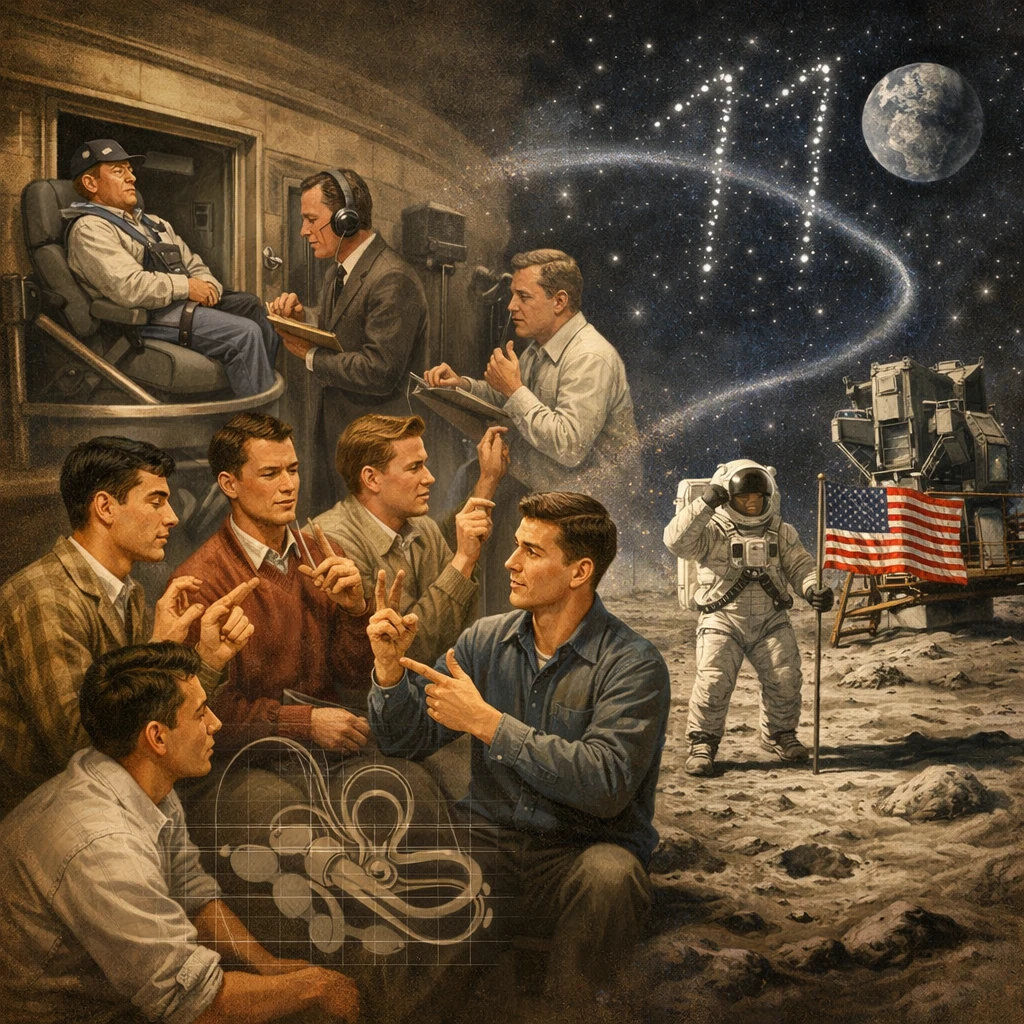
This past week, the world watched four astronauts climb into a capsule called Integrity and fly to the Moon and back for the first time in over fifty years. Artemis II splashed down in the Pacific on April 10th, carrying Reid Wiseman, Victor Glover, Christina Koch, and Jeremy Hansen farther from Earth than any crew since Apollo.
It was a big deal. And watching it, I kept thinking about eleven men most people have never heard of — men who quietly helped make all of this possible. I knew the Gallaudet 11 were involved in space experiments. What I didn’t know was just how deep that involvement went — that their work quietly laid the foundation for human spaceflight as we know it. That’s the part that got me.
The Problem
Back in the late 1950s, NASA had a serious question it couldn’t answer: what does weightlessness actually do to the human body? Specifically, they were worried about the vestibular system — your inner ear — which is basically your brain’s GPS for knowing which way is up. In zero gravity, it gets confused. That confusion causes nausea, disorientation, and the kind of mental fog that could make it impossible to fly a spacecraft.
To understand the inner ear’s role, they needed people without one. Which is a surprisingly hard thing to find.
Enter the Gallaudet 11
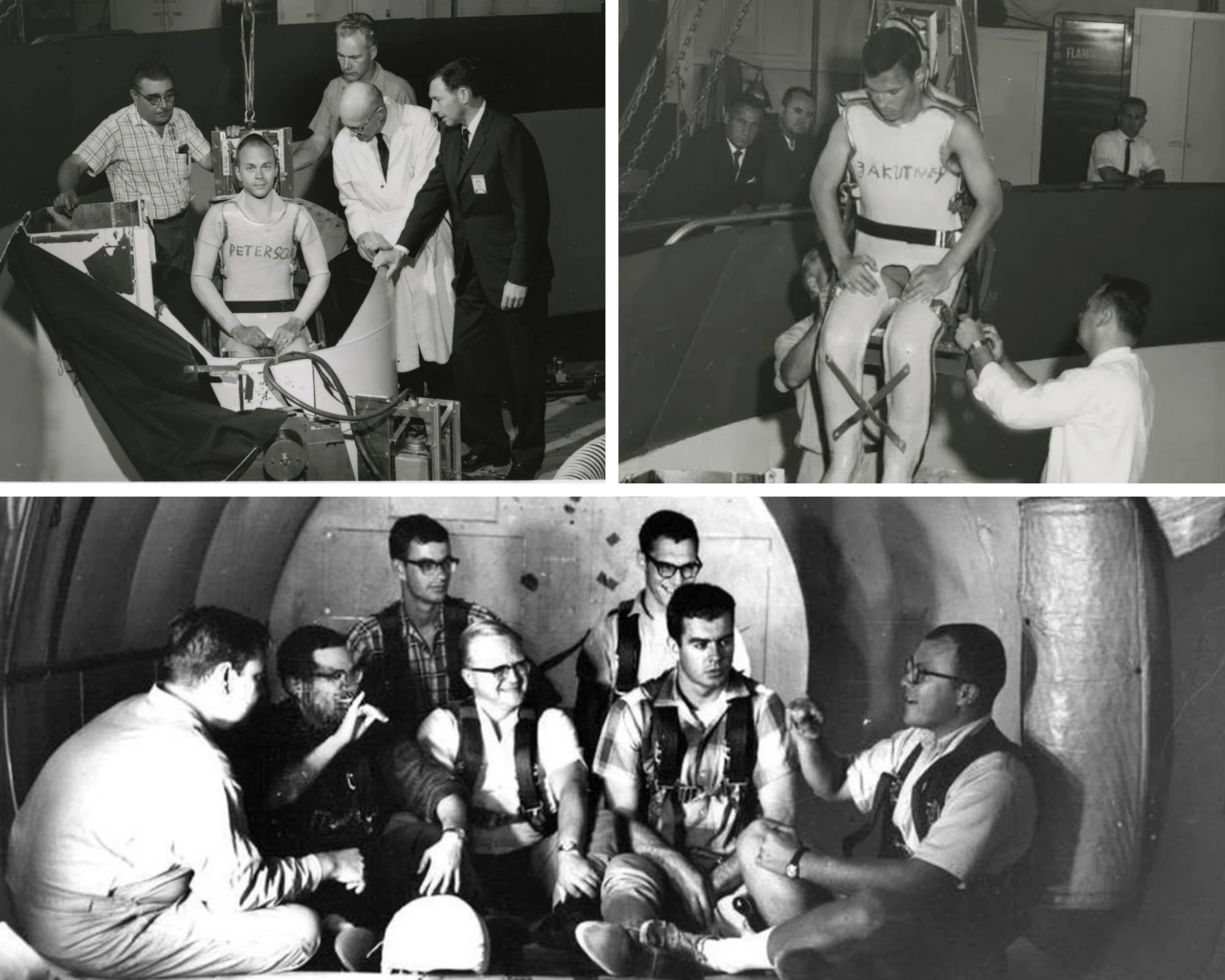
Between 1958 and 1968, NASA teamed up with the U.S. Naval School of Aviation Medicine and recruited eleven Deaf men from Gallaudet University. Most had lost their vestibular function as kids due to spinal meningitis. Their inner ears didn’t send balance signals to their brains at all.
Worth noting: they weren’t chosen just because they were Deaf. Not all Deaf people have altered vestibular systems. NASA needed this specific combination — Deafness plus damaged inner ear function — and Gallaudet was the most likely place to find a group of people who fit that profile. That distinction matters.
To NASA, these eleven men were a perfect control group. To the rest of the world, they were largely invisible.
The Experiments
The tests were wild. One had participants living inside a 20-foot room that spun at up to ten rotations per minute for days at a time. The researchers running the experiment got so sick they had to be rotated out. The Gallaudet 11 played cards and hung out, completely unfazed.
Another test took place on a ferry off Nova Scotia during a storm. The boat was tossing hard enough that scientists were genuinely scared. The researchers got so sick the experiment had to be called off. The Gallaudet 11 were relaxed, enjoying the ride.
On zero-gravity flights — the ones nicknamed the “Vomit Comet” — they were the calm ones in the room, doing their tasks while everyone else reached for a bag.
Why It Mattered
Their data gave NASA something it couldn’t get anywhere else: a baseline. A clear picture of what the body does in extreme conditions when the inner ear isn’t involved. That knowledge shaped astronaut training, helped develop anti-motion-sickness drugs, and informed how many Gs a crew could safely withstand. It had applications far beyond the space program.
They weren’t consulted or accommodated. They were essential.
Deaf Gain
There’s a concept in the Deaf community called Deaf Gain — the idea that traits the hearing world frames as losses can, in the right context, be genuine advantages. The Gallaudet 11 are one of the most concrete examples of that you’ll ever find.
These men didn’t accidentally stumble into history. They showed up, did the work, endured a decade of experiments, and handed NASA the knowledge it needed to send people to the Moon. Then they went home, and the world mostly forgot about them.
If you want to dig deeper, NASA has a solid writeup on their contributions. There’s also a brand new picture book — The Gallaudet Eleven: The Story of NASA’s Deaf Bioastronauts — written and illustrated by Deaf creators, just out last month.
Next time you watch a rocket launch, remember: the foundation was built by people the history books skipped. 🚀
The Gallaudet 11 experiment proved that Deaf people aren’t just capable of contributing to space exploration — they were essential to it. And the story didn’t stop there. In 2017, Johanna Lucht became the first Deaf engineer to carry out an active role in NASA mission control during a crewed research flight. And Julia Velasquez — a Gallaudet graduate who interned at NASA and Kennedy Space Center, got her aviation pilot’s license, and completed astronaut training in a Mars habitat simulation — has been pushing the door open even further.
Deaf people are already inside NASA. Already training. Already proving it’s possible. So here’s my question: Artemis III is next. Will we finally put a Deaf astronaut on that crew?