

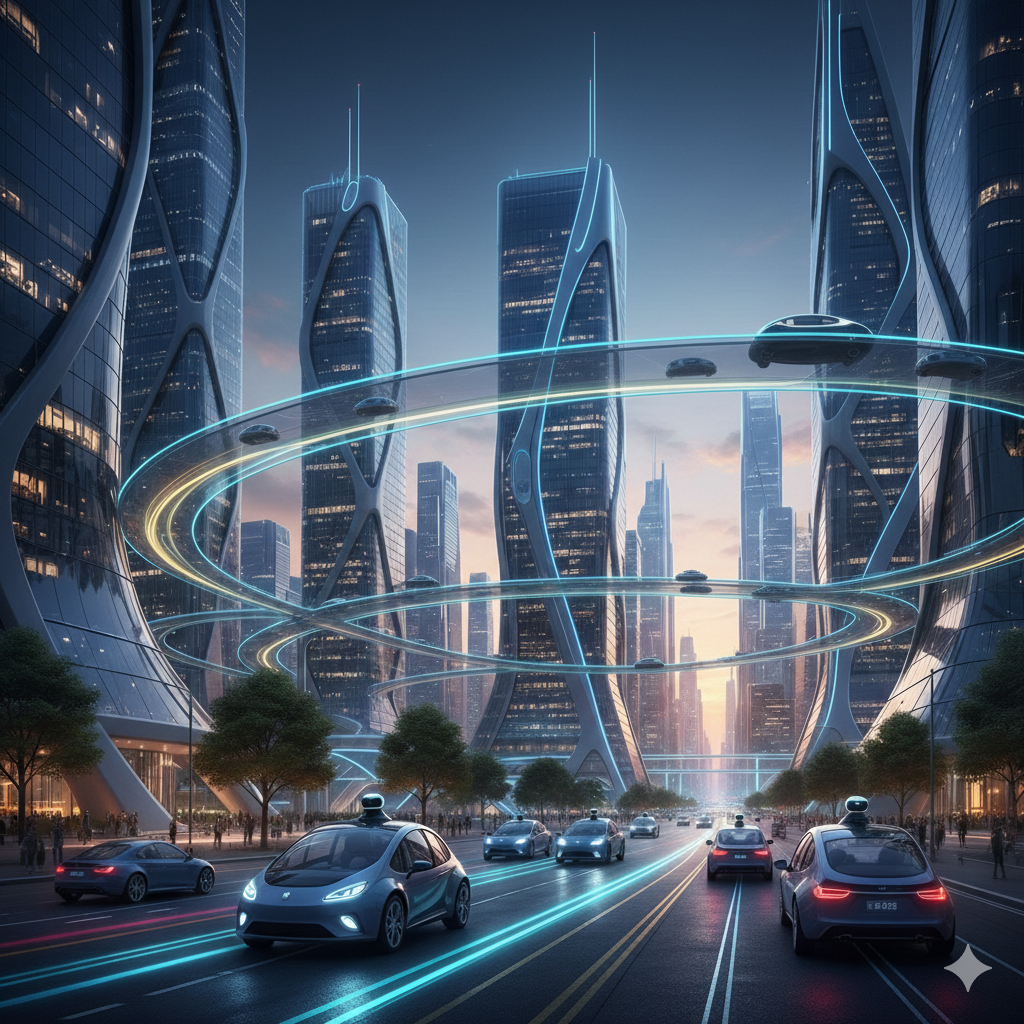
Okay, I have to talk about Waymo.
I keep seeing these headlines and every time I do, it gets more real. Because "someday" just became Tuesday.
Here's the short version: self-driving cars are no longer a "someday" thing. They're here, rolling down real streets, in real cities, picking up real people. And they're spreading fast.
Remember when self-driving cars were just a movie thing? Johnny Cab in Total Recall. The automated highways in Minority Report. It all felt so far away. Now they're actually real. And they're coming to a city near you.
This started as a quiet Google experiment back in 2009. Fifteen years later, here we are. They launched their first fully driverless service in Phoenix back in 2020 — no driver, no steering wheel, you just get in and go.
They're already here. Waymo just hit ten cities — Dallas, Houston, San Antonio, and Orlando just got added to the list all at the same time, which is apparently a first for them. Chicago and Charlotte are being mapped as we speak. By the end of this year, they'll be everywhere from D.C. to London, per TechCrunch and The Driverless Digest.
And London. They're going international.
It's moving fast. Faster than I think most of us are ready for.
I always knew this day was coming. I just didn't think it would be here so soon. It makes me wonder — in a few years, will we see more robot cars on the road than human Uber and taxi drivers?
🤖 Waymo By The Numbers
- 200 million fully autonomous miles driven as of February 2026
- 450,000 rides per week right now
- 1 million rides per week targeted by end of 2026
- 10 cities currently operating
- 80% fewer injury crashes than human drivers
- KitKat count: 1 cat, 1 dog, infinite internet outrage
Okay But Are They Safe Though?
I'll be honest — my gut says no way. There is something inherently terrifying about a car with an empty driver's seat. But because I'm a geek for the details, I had to actually look up the safety data.
The numbers are kind of humbling.
Between 2021 and 2025, there were about 1,400 incidents, according to NHTSA crash data analyzed by DiMarco Araujo Montevideo. At first glance, that sounds like a lot. But when you peel back the layers, humans are almost always the ones causing the mess. We're rear-ending them at stoplights or drifting into their lanes while they're just... sitting there.
I had to read that twice. Honestly, I expected it to be much worse.
In fact, a peer-reviewed study in Traffic Injury Prevention showed Waymo has 80% fewer injury crashes than we do. One neurosurgeon even called it a public health breakthrough.
There were two recalls. One in 2024 when a Waymo bumped into a utility pole in a Phoenix alley — no injuries, software patch pushed, done. Another in 2025 for a glitch that caused minor bumps into gates and barriers, same deal, according to DiMarco Araujo Montevideo's NHTSA analysis.
The data says they're safer than us. Measurably, statistically, peer-reviewed safer. Human drivers are literally crashing into them more than they're crashing into anything.
The KitKat Factor
Of course, the internet doesn't care about a "public health breakthrough" as much as it cares about KitKat.
If you haven't heard, a Waymo ran over a neighborhood cat named KitKat in San Francisco, per eWeek. Then a dog. People rightfully lost their minds. It's a strange quirk of human nature — we'll forgive a human driver for a mistake because "we've all been there," but we expect the robots to be perfect. 100%, 24/7 perfection. Anything less feels like a betrayal.
Oh, and one more thing. Waymo can navigate a city, avoid crashes, and handle a six-car pileup. But if a passenger forgets to close the door when they get out? The car just... sits there. Stuck. So Waymo teamed up with DoorDash to pay gig workers to come close the door so the car can move again — up to $24 a pop in Los Angeles, according to CNBC.
So, Would You Get In?
I asked myself that a lot while writing this. Honestly, I'm terrified. I'd be white-knuckling the door handle for the first five miles, sure. But if the data says the robot is 90% less likely to get me into a serious wreck than the guy next to me who's currently texting and eating a burrito? I'm always the one trying out new products just to see what the fuss is about. Robots in my living room? That's a no. But a self-driving car taking me across town? I'd probably get in.
Are you hailing the robot, or keeping both hands on the wheel for as long as they'll let you?
What's Next?
If you thought the current rollout was fast, it's only getting bigger.
Waymo is retiring the Jaguar I-Pace and rolling out a brand new vehicle called the Ojai — a purpose-built electric van made by Chinese automaker Zeekr, with no steering wheel and no pedals, per Inside EVs. They're also adding Hyundai Ioniq 5 robotaxis to the fleet. So in a few years you might hop into a Waymo and it won't even look like a car you recognize.
And the scale they're targeting is wild. Right now Waymo does about 450,000 rides a week. By the end of 2026, they're aiming for one million rides a week, according to Investing.com. That's not a small jump. That's a full sprint.
Oh, and Tokyo is also on the list. So it's not just London. They're going global.
And here's the detail that got me — they've been testing in Detroit and Minneapolis specifically to prove the system can handle snow and ice, according to CNBC. Because let's be honest, a self-driving car that only works in sunny California isn't that impressive. A robot car navigating a Minneapolis blizzard? Now that's something.